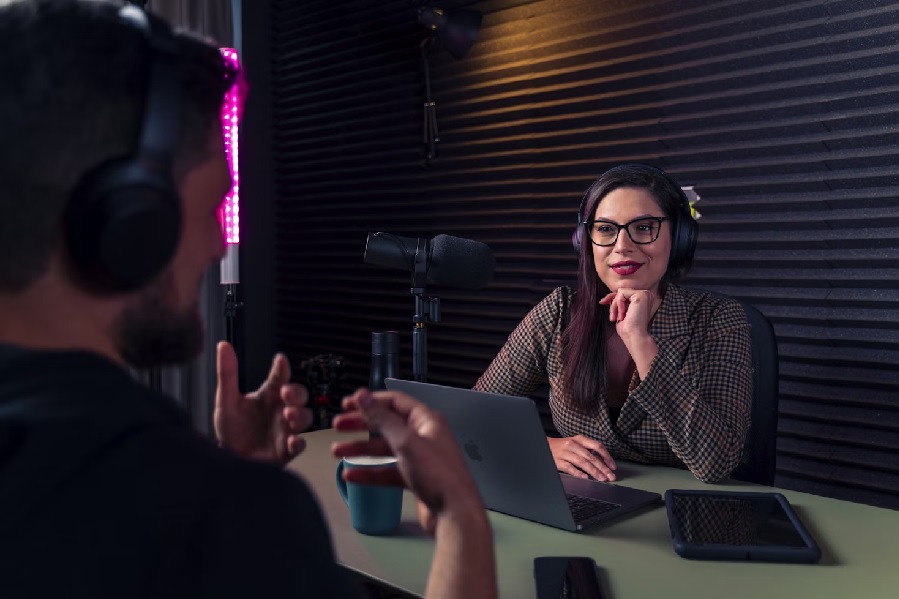
Interview is one of the most important format of Broadcasting like Feature, Drama, Discussion, Investigative reporting, Documentary. But today Interview is focused with reference to current affair programme.
The Interview – an exchange between a journalist or presenter and a source of information – is a difficult art. It requires good preparation, knowledge of technique, heightened people skills, in other words paying attention to others. It should be thought of in terms of goal-focused strategy.
Stages of the Format:
Generally, all interviews have the following three steps:
- Introduction or The Opening,
- Relevant Question/ The Body,
- Wind Up/ Sum Up.
- Introduction / The Opening The opening clearly identifies you, your subject and the topic. This allows your audience to know “up front” whether the interview has any direct interest to them. Additionally, the opening can give your location to establish a local tie-in or explain any background noises.
- The Body The body is the interview itself — the actual questions and answers. At this point, the interview takes shape and becomes a reality.
- Wind Up The closing is an abbreviated form of the opening. During the closing, you can summarize briefly the content of the interview and once again identify yourself and your guest. The opening and closing may be the most important parts of the program, since the opening grabs the audience’s attention and the closing provides a conclusion to the story being told. After you have determined the focus of the interview and formulated your questions, you may write and record the opening and closing before you talk to your guest (if time permits). Don’t be in a hurry to end the interview. Much information may be relayed in small talk and casual conversation when the interviewee thinks the interview is over. Review investigative notes with the interviewee carefully to ensure agreement as to what the issues are and what was said about them). If you want ambient (natural) sounds for the opening and closing of a radio interview, take your script along and read it at the interview site.
Types of Interview
There are six different types of interview:
- ‘Subjective’ Interview. Get information from your interviewee about his or her expert subject, or about something he or she is well-positioned to talk about.
- ‘Personality/ Objective’ Interview. Bring out the personality of the interviewee on the air.
- ‘Witness’ Interview. Have a witness to an event.
- ‘Declaration’ Interview. Ask the reaction of someone involved in the news, or of a politician for their immediate reaction to a story or meeting in which they have taken part.
- ‘Vox Pop’ Interview. Survey a slice of the population to give a reflection of public opinion about a news story/ happening.
- ‘Off the Cuff’ Interview.V.I.P’s short statement about any event he witness.
HOW TO PREPARE AN INTERVIEW?
For every spoken word programme research is essential.
1st Research
Research is crucial. The pertinence of your questions and your capacity to resist being manipulated depends on how good your research has been.
2nd Making contact beforehand
Making contact with the person before the interview should give your interviewee a better understanding of what is expected of him or her, and in what context the interview will be used. It also means you can assess whether or not someone will make a good interviewee.
3rd Preparing the questions
How you prepare your questions will depend on two criteria:
- Whom am I interviewing?
A politician, a colleague, the man in the street, an expert, a celebrity. You will tailor your questions in quite a different way for each.
- What is it for?
A news bulletin, a current affairs programme, a general interest broadcast. The format and the atmosphere should be adapted for the different types of programme.
4th Preparing your equipment
- Make sure your recorder is working properly (microphone, cable, tape, cassette, head phone, mini-disc, plug, batteries, etc) by doing a quick recording and listening back to it.
- If the interview is to take place outdoors, take along a microphone wind-shield.
THREE INTERVIEW TECHNIQUES
The Non-directive Interview: Begin with “Tell me about…” never use a question. This approach leaves the interviewee free to say whatever he or she likes without limiting him or her to the parameters of your own knowledge of the subject. You can then go back over the most important points raised, “sum up” each along the lines of “you were saying…” This method of interviewing is best for bringing out lots information, but it is the most difficult to master.
The Directed Interview: Only use questions, more or less open ones. The interviewer knows about what they are discussing, and sometimes even knows the answer he will get, but needs the interviewee to confirm the information.
The Semi-directed Interview: Alternate the questions between those which guide the interview to where you want to go and those which may invite interesting and enriching elaboration.