
Sindh, a land stretching from the coastline of the Arabian Sea to the great Thar and Kohistan desert and small and fertile belts along the River Indus. Karachi, the only port city of Pakistan, serves as a gateway to Pakistan. Almost all-external trade is facilitated through the two major operating ports viz Karachi Port and Port Qasim. It is the largest city of Pakistan with a population of 11.5 million. It has emerged as the industrial, financial and commercial hub of the country. Nature has blessed Sindh Province with ideal climate suitable for growing a wide range of crops, fruits and abundant supplies of seafood, minerals and manpower resources. Sindh is a region, which has been and still is very rich in handicrafts. The textiles are very famous especially block printing and tie-and-dye. It also enjoys a reputation for reputation for textiles, pottery, clay, curved furniture, leatherwork and carpets. The craftsmanship of the people of Sindh began during the period of Moenjodaro civilization and has won praise.
History:
Sindhi refers to an Indo-Aryan language speaking socio-ethnic group of people originating in Sindh which is part of present day Pakistan. Sindhis that live in Pakistan are predominantly Muslim, while many Sindhhi Hindus emigrated to India when British India was divided in 1947. Some Sindhhi speaking people of formerly untouchable castes known as Haris and practising what is generally known as folk Hinduism are still found in rural Pakistan. Sindh is one of the four provinces in Pakistan located at the Southern border. The province of Sindh has its name derived from the famous River Indus. In Sanskrit, the province was dubbed Sindhu meaning an ocean. Around 3000 B.C, Dravidian cultures developed and give rise to the Indus Valley Civilization. According to the Historians, Indus Valley Civilization declined due to the natural disasters such as floods but the invasions of Indo- Arians caused the sudden collapse of it. In the recent history, Sindh was conquest by the British in 1843. Sind province remained the part of British India until 1947 when it was made one of the provinces of Pakistan.
Language:
Sindhi language evolved over a period of 2400 years. The language of the people of Sindh, after coming in contact with the Aryan, became Indo-Aryan (Prakrit). Sindhi language, therefore, has a solid base of Prakrit as well as Sanskrit, the language of India, with vocabulary from Arabic, Persian, and some Dravidian descendants from Mediterranean sub-continent. Initially, Sindhi had close contacts with Arabic speaking Muslims. Therefore the language adopted many of the Arabic words. Sindhi language is also greatly influenced by Sanskrit and about 70% of the words in Sindhi are of Sanskrit origin. Sindhi is a very rich language with a vast vocabulary. This has made it a favourite of many writers and so a lot of literature and poetry has been written in Sindhi. It has been the inspiration for Sindhi art, music, literature, culture and the way of life. The language can be written using the Arabic script.
Festivals:
The people of Sind love their religion and the two festivals of Eid-ul-Adha and Eid-ul-Fitr are celebrated with zeal and enthusiasm. Different domestic festivals are arranged by the local people to provide people with new things they buy on Eid’s occasion. On different occasions, the Folk dance of Bhagat is also performed by professionals to entertain the visiting people. Hence, a Sindhi Cultural Festival is a compound of folk dances, music and cheap entertainment for local people.
Arts and Music:
Sindhi society is dominated by great Sufis, the mystics and the martyrs. It has always been the land of peace, love, romance, and great cultural and artistic values. There were the great theologians of the Naqshbandi order in Thatta who translated the fundamentals of the religion of Islam into their mother tongue. There were the great Sufi (mystic) poets like Shah Abdul Latif Bhitai who was the cherisher of truth and spent all his life in its propagation, pursuit and quest. Bhitai was also an excellent musician. He invented a new type of musical instrument, Tambura which till today, is a primary source of music in rural Sindh. The beauty of Shah’s verses is enhanced by his blending of traditional Indian rag with the Sindhi folk songs and music. Sindhi handicrafts have been popular throughout the world. These handicrafts are found from the time of Indus civilization they shown the same tradition and customs. Modern handicrafts evolved after much alteration. The invasions during ancient period led to culture exchanges that in turn flourished. The Indus civilization showed a remarkable artistic skill and century’s old tradition of handicrafts.
HERE IS A LIST OF VARIOUS CRAFTS OF PAKISTAN
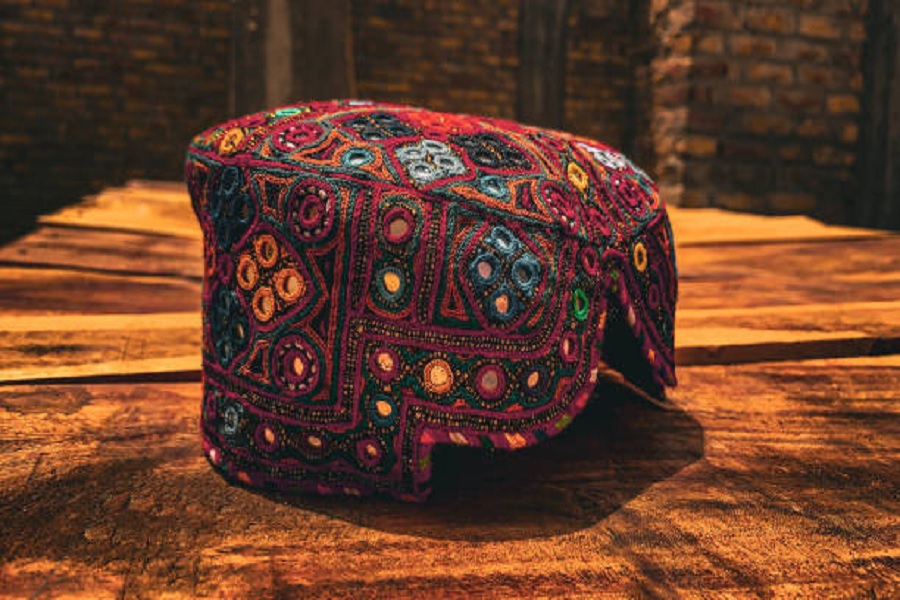
There are some of the major crafts of sindh are pottery, straw basketry, carpet and floor covering, camel skin crafts, metal crafts, costume jewellery of white metal, glass beads and bangles, leather jewellery, doll making, wood crafts, camel bones crafts, Sindhi cap. Ajrak, kasha, rilli, date leave products, ceramics , embroideries, farassi rug, jandi, khes, musical instruments, fesh products, Thari carpet.
Textile Crafts:
Rally, Ajrak, Block Printed articles, silk and cotton and zari thread embroidery, mirror work embroidery, hand woven fabrics and khes (bed spreads). Textile crafts one of the oldest crafts in the subcontinent. These crafts are learning from generations and a whole family works on these crafts. The range of designs employed on to these articles is enormous and the media of weaving, printing, embroidery and appliqué numerous.
Patchwork or appliqué work rally (bed spread) is a popular rural crafts of Sindh. Carefully cut pieces of cloth in desired shape are hand stitched on the base of material in geometrically arranged pattern merging the skill of crafter with spirit of tradition.
Ajrak is a technique of wooden block printing on cotton texture with a mixture of vegetable dyes involving some sixteen processes .in Ajrak both floral and geometrical Patterns are employed.
Hand Woven sussi fabrics and khes (bed spread) are also traditional rural crafts of sindh. Sussi is the name given to hand woven cotton or silk fabric in striped pattern and khes is hand woven bed weave.
Sindh has distinct folk tradition in embroidery employing interlace stitches with silk, cotton; metallic threads. Sindh is also the home of mirror embroidery with its myriad reflection of light on bright colored base materials. Circular pieces of looking mirror are held together by the bottom hole stitches in the formal and exotic geometrical arrangement. Ladies in their home make these pieces and earn a little earning to support their family. Bold lines and bright colors are striking feature of rural embroider. Entire background is ornamented with thread and mirror work. Costume embroidered with such orientation becomes symbol of traditional and cultural festivity. This embroidery is used widely on dresses, caps, table cover, cushion cover and runners.
Tie and dye is one of the traditional dyeing styles in Pakistan one of traditional form of tie dying began some 5000 years ago. Called as bandhan. Its techniques involve tying small dots with tread all over the fabric to create designs and motifs. After tying the fabric is dyed. Then the ties are removed and a beautiful pattern form on the fabric. Leheria pattern is also very famous in tie-dye work. Leheria means waves. Each lehrai design is unique.
Straw Basketry:
The golden straw has for many years helped to rear the art of weaving decorative basketry. employing masterly skill and conforming happily to the theme of regional traditions, the straw weaver weaves the patterns of many a functional and decoration articles like trays ,plates, low rim baskets in round and oval shapes, bread baskets with high rim and cover lid conventional hand fans and folk toys.
Glazed pottery:
The glazed pottery of Sindh has traditional craft. And portrays influence and symbols of Indus valley Civilization of 3500B.C. The potter with age old skill turns out a wide range of functional and decorative articles. The forms of article s are elegant, bold and balance and the designs floral or geometrical and the glazes reflecting colors and shades of blue, golden, crimson and cinnamon brown and sometimes green also. The famous hala pottery is beautiful and unique.
Traditional floor covering:
Pakistan has a place in the export trade of hand knotted woolen carpets in world markets. Hand knotted carpet is a product of the skill of designers and weavers mingled in the technique. Designs are harmoniously set in a formal array of floral or geometrical arrangements and knotted is done on the loom by skillful fingers of hereditary craftsmen. To watch them at work is very fascinating and interesting.
Daree is a hand woven product with harmonious Combination of cotton warp and woolen weft. Daree woven in exquisitely designed floral, geometrical or abstract patterns make an attractive floor covering with quality of durability and fancy of colorful setting.
Farashi is the traditional name of hand woven floor covering .it is an old rural craft of Sindh cleverly conceived with the combination of hand spun yarn of camel, goat hair in natural color and cotton yarn. Designs employed in farashi are either simple striped or intricate geometrical. Farashi being strong in texture makes durable floor covering coupled with glitter of tradition.
Namda is cultural name of a felt carpet and has set a tradition as a floor covering. it is made of pressed rolled wool which makes the base for woolen yarn embroidery onto. Designs are generally styled depicting flowers and leaves, animal, figures, folk life and scenic views.
Camel Skin Crafts
The tedious technique of shaping the camel skin crafts and decorating them with indigenously prepared lacquer colors is a age old tradition. the camel skin is first cleared to become transparent clear and then stretched on clay moulds of the desired objects to attain the firm shape. the shaped articles are then merrily decorated with high degree of excellence in floral or intermingled geometrical patterns in bright colors. Decorative chronicles and miniature, natural land scape, royal hunting scene and animal figures and birds are also transformed in bright color onto camel skin objects with masterly skill to produce impact of realism and impressionism. Conventionally table lamp, hanging. Lamps, vases, bowls are produced. This crafts is mostly produce in Multan and Bahawalpur district.
Costume Jewelry:
White metal (German silver), glass beads, glass bangles and leather jewelry).The tradition of jewelry in some form or other goes back to the first strings of civilization .it being their Devine right, the women in prehistorically period also used to adorn themselves with garlands, girdles, bangles, bracelets and ear-hanging made from fresh natural flowers or crafted with clay, semi precious stones, sea shell, fish bone or elephant tusk or made of alloy of metals.
With the advancement of cultural and traditional aesthetics and influenced with gold and silver, precious stones and diamonds and lately the white metal (German silver an alloy of copper, zinc and tin) the theme of costume jewelry under went harmonious changes. White metal wire when given shape by skilled figures of craftsmen to form lightweight costume jewelry in a variety of traditional designs and motifs is called filigree work. Crafted by hand the simple colorful glass beads in countless shapes, shades and designs reflect both variety and perfection in form and treatment. Elegantly made glass beaded string necklaces and bracelets are in fancy and fashion for casual wear. Glass bangle making is an art and we will see this in home factory where the young girls and ladies work on these high quality bangles with liquid gold and silver powder. Crafted by hand the simple, plain or decorated multicolored glass bangles are taken by womenfolk as joyful and festive way of adoration. Handcrafted colorful glass beads in countless shapes, shades and designs reflect both variety and perfection in form and treatment and master craft ship of these womenfolk.
Leather jewelry is a craft of recent origin. Prevalent indigenous talents introduced techniques of producing ornamentation items with leather intermixed with aesthetic harmony of shinning brass and anodized aluminum fittings and decorations. Leather jewelry has its own peculiar features and facets. Designs and shapes of components f leather jewelry are mostly modern conforming to tastes and trends of the young generation. Brown, light brown, black, red and blues shades of leather are used to produce a variety of necklaces, bracelets, bangles, and earring, finger rings.
Costume Dolls:
From age to age, people to people and from hand to hand, the art of doll making as a crafts has survived and flourished towards perfection. The villages folk have preserved the ancient medium of rag dolls. The rag dolls made by village women in their homes are primitive as well as exotic. Besides folk crafting of rag dolls, costume doll making has now been adopted commercially. Body of a doll is shaped with steel wire and stuffed with cotton and face moulds and facial features produced through techniques of painting. The clothes and apparels of these dolls reflect national and regional peculiarities. Again in home industry women and young ladies work to earn decent living for them.
Camel Bone Crafts Crafting of artistic articles from ivory is an age-old tradition and backed by royal patronage it developed it developed to high esteem for the lovers of art. Ivory getting rare these days, the camel bone has been substituted. Laborious process is involved in curing, cutting and crafting small utility items of costume jewelry and accessories out of camel bone. Work with extremely delicate and intricate carving, engraving, embossing and perforating in floral or geometrical designs and patterns with high degree of perfection.
Onyx Crafts:
Pakistan has been bestowed by nature with multitude reserves of onyx in the mountains in the province of Baluchistan. Onyx comes from the family of marble but is distinctive for its beautiful colors and shades. The colors range from light green to medium and jade green, from copper brown to dark brown and within each color the varying effects of dark, medium and light shades interplay through the veins. Onyx has unique quality of being transparent against light. The technique of inlaying the delicately cut and shaped multicolored sea shells onto onyx crafts in floral or geometrical designs and patterns had historical linkage with century’s old art of inlaying diamonds and gems onto the object of marble. A variety of articles are produced like vases, flowerpots, lamps, bowls, plates, goblets &jars.
- Asada Sensei’s Residence (May 06, 2002, Noorjehan Bilgrami). There are some spectacular burial sites in Sindh. The Chawkandi and Makli tombs, are like a conglomeration of gold-jeweled sculptures in the stark desert. Intricately carved to a depth of three layers the patterns are reminiscent of Buddhist, Hindu and Central Asian influences. These incredible carvings that are timeless, illustrate the similarity of motifs in the design repertoire of other traditional crafts of Sindh. The people of Sindh have a deep reverence for ajrak. From birth to marriage, until death, ajrak celebrates all significant events of the life cycle. This cloth has many different usage in everyday life. It is worn as a turban, a shawl, spread as a bed-sheet or tablecloth and when worn out, it is recycled as a hammock for a baby, cover for a bullock cart and most commonly used as a backing to patchwork quilts. It is used and reused till threadbare. Ajrak is a cloth worn by different income groups, from the wealthy to the poor. The colors, patterns and design-format remain the same, only the quality of the fabric is different.
Ajrak making process:
Nature plays an important role in the making of Ajrak. The craftsmen work in total harmony with their environment, where the sun, river, animals, trees and mud are all part of its making.
Cloth is torn into sheets and taken to the river to be washed. The damp cloth is then coiled and placed on top of a copper vat and the bundle covered with a quilt to prevent the steam from escaping.
This vat is heated by a log fire, through the night and the next day. The steam opens the pores of the cloth and makes it soft so that the impurities can be easily cleansed. This process is called Khumbh.
In the next stage, called the Saaj, the fabric is soaked in a mixture of camel dung, seed oil and water. The dung enables the cloth to become softer and acts as a bleaching agent. This stage is very crucial in determining the quality of an Ajrak. The wet cloth is then tied into an airtight bundle and kept for 5 -10 days, depending upon the weather. A distinct smell of mango pickle emanating from the bundle confirms that the fibers have been well soaked with oil.
The cloth is then dried in the sun and it goes through another oil treatment. The oil is curdled with Carbonate of Soda solution and the cloth is soaked in this mixture to ensure that the fibers receive maximum oil. After a thorough wash in the river the next day, they are soaked in a mixture of Sakun made with Galls of Tamarisk, dried lemons, molasses, castor oil and water. The women usually prepare this mixture at home.
Till now the cloth was only given a base preparation. The wet cloth after drying is then brought to the workshop for printing.
At this point I shall digress a little to talk about the wooden blocks. They are carved from the Acacia Arabica trees, indigenous to the Sindh region. The repeat pattern, which gives the design its character, is determined by a grid system. The pattern is first transferred to the block and then carved with great precision by the block-maker, who uses very simple tools. The blocks are carved in pairs that can register an exact inverted image on the other side. Today, there is only one surviving member of a family of block-makers whose forefathers were skilled in this craft.
Back to the process: Kiryana, is a resist made with rice paste, Acacia gum and lime. Using the outline block, the printer dips his block in the paste contained in a small terracotta tray, to print on both sides of the cloth. The printed pattern remains white.
The second is the printing of the black areas called Kut, a mixture of Ferrous Sulphate, Fuller’s earth, gum and water is stamped on the cloth with a filler-block.
For the next stage, gum is mixed with rice paste, alum, molasses, fennel, Fuller’s earth and other herbs to form the mud resist-paste, called the Kharrh which is printed on the areas that are to be protected against indigo dye, that is, the white, black and the portions that are to become red.
The cloth goes through the first indigo dye, which unfortunately, is now synthetic indigo, as the usage of natural dyes had been abandoned over 50 years ago. Usually the master-dyer, known as the Usto himself does the dyeing in the vat. The dyed cloth is then taken to the river the next morning before sunrise.
All the sheets are submerged in the water for at least an hour. To a rhythmic count, the craftsmen swish and thrash the Ajraks in the water for an hour or more until the gum and the excess dye have been washed off and the white areas become clear Vicharrh.
Heated by log fire the craftsman diligently lifts and immerses the cloth repeatedly for a couple of hours till the desired red color is reached.
On the banks of the river, for taai, the red Ajraks are spread out to partially dry in the sun, the artisan scoops the water to sprinkle on the cloth. The alternate drying and drenching of the cloth bleaches the white areas and deepens and matures the other colors. This continues for a couple of hours before they are washed, dried and then taken to the workshop.
The mud resist mixture is again printed to cover the red areas and immediately sprinkled with the sifted, dried, cow dung to dry the wet areas, called Meena.
The thick, mud-encrusted cloth is folded and slowly lowered in the indigo vat for the second time. The Ajraks are dried, rolled into a bundle and then taken to the river for the final wash. The craftsmen fold the Ajraks while still damp and the weight presses them as they become dry.
Will there be a continuity of this ancient laborious craft tradition? The younger generation is seeking more lucrative work that is less labor-intensive with short-term gains. Some are taking short cuts by reducing the number of essential stages in the making; others simply have switched to printing cheap silk-screen versions.
To sustain any craft, the product has to be economically viable. Alternative markets have to be explored and developed, since the traditional social structure is going through a major change. As time passes, festivals and ceremonies play a less significant role in their lives. Political uncertainties, fashion and consumer dictates and pressures from the urban areas are all contributing to change that is not relevant to their way of life.
The continuity of Ajrak has persisted over centuries only because it is an integral part of Sindhi culture. Its usage is evident at all levels of society and the cloth is held in high esteem with the utmost respect given to it.
I conclude with a quotation from an anonymous author:-
“What do we perceive of his life,
his secret joys, his anguish?
For there are so many alternative solutions –
but there are also many richness,
the web, faith and penetration of his eyes and hands,
and the joys that are fast disappearing.”
Sindhi Regional Music;
Sindhi music is generally performed in either the “Baits” or “Waee” styles. The Baits style is vocal music in Sanhoon, low voice, or Graham, high voice. Waee music is instrumental performed in a variety of ways using a string instrument. Waee is commonly known as Kafi and also found in these surrounding areas of Balochistan, Punjab, and Rajasthan. Common instruments used in Sindhi regional music include the Yaktaro, Narr, and Naghara.