
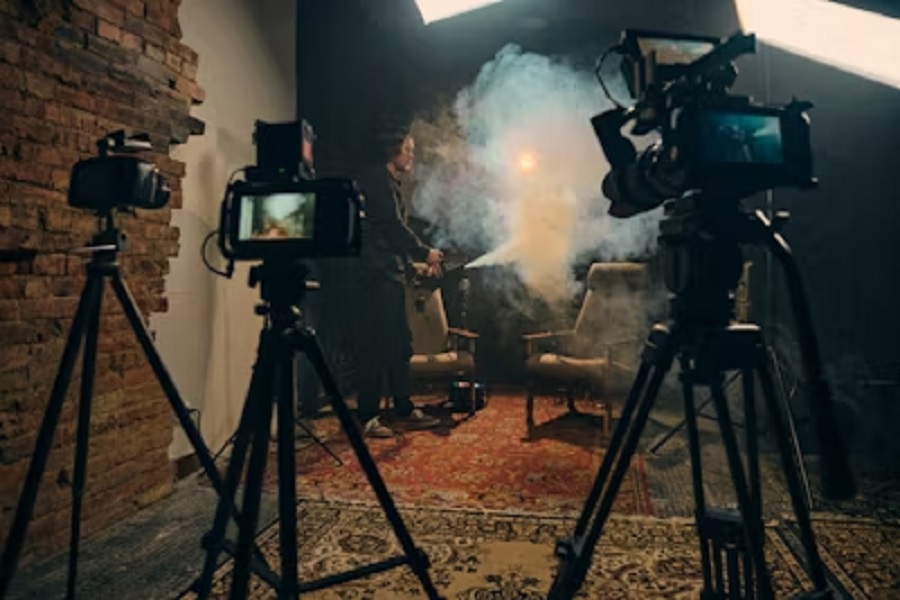
Pre-production Planning
Now you have to deliver what you promised in the proposal. We call this the communication and coordination stage in the production process. You now need to talk to a variety of people and communicate to them your production needs.
You must now identify the people who are directly or indirectly involved in your production planning and establish clear communication channels among them.
Planning Personnel
As mentioned before, production personnel are classified as “above-the-line” and “below-the-line”. The above-the-line production personnel includes people who are mainly engaged in non-technical activities and do not operate equipment, such as writers, directors, art directors, talent, and the various production assistants.
Below-the-line personnel generally includes people who operates equipment or supervise such activities. They include studio supervisors, technical directors, camera operators, audio technicians, lighting directors, floor managers, videotape editors, VTR operators, and so forth.
The people involved in the planning stages of production come from the above-the-line category.
The writer will interpret the process message into a television presentation and translate it into a television script. Make sure hat the writer understands the program objective and, especially, the proposed process message.
The director will translate the script into specific video and audio images and suggest the basic production type.
The art director will suggest appropriate set designs and graphics that give the show a specific “look” or will develop a preliminary storyboard for a commercial. The overall visual style must satisfy not only the requirements of the process message but also your and the director’s perception of the overall show design.
Production Equipment
Although you do not have to be an electronics expert to be a good producer, you do need to know the major production equipment and how it works. Consult with your technical staff on specific use of equipment and other production tasks.
Their expertise extends way beyond the use of television equipment, and they are usually quite willing to help you.
Production Personnel
In order to coordinate the production team, you must know the precise functions and responsibilities of each of the above –the-line and below-the-line production people and the lines of communication among them. There is nothing more frustrating to a production team than having a producer initiate certain actions without involving or informing the people who are ultimately responsible for them.
Scheduling
The most careful planning of personnel, equipment, and studios or other production space is of little use if they are not available when you need them. You will find that scheduling is more difficult than first expected and that you have to be patient and prepared to compromise. Unless you have production facilities and crews assigned to you on a regular basis, you should start with the production schedule and then recruit the above-and below-the-line production people and equipment. Have your schedule confirmed by all parties in writing.
Additional Production Factors
Most productions involve facilities and people that, ordinarily have no connection with your station or production company. These production elements need special attention. For example, you may need a permit from the city hall and police department to shoot downtown. If you have an out-of-town actress on your interview show, there are several small, but important, production details that need your attention. Are there make-up facilities, however modest?
If your production occurs outside the studio, such production details and the list of questions increase manifold.
Production Process
As soon as you have the go-ahead for your project, you need to start the actual production process. This process includes many phases that sometimes progress in a logical and comfortable sequence, sometimes overlap, and sometimes seem out of control. Keep that in mind as we review that following principal production steps:
- Production method and scope,
- Talent,
- Below-the-line personnel,
- Initial production conference,
- Script conference,
- Final scheduling,
- Facilities request,
- Log-information,
- Publicity & promotion and
- Rehearsals & performance.
Production Method and Scope
Although the basic production method has already been determined at this point–whether, for example, to use a multi–camera setup in the studio or to do an on-location, single-camera show-return to the process message and check whether the chosen method is, indeed, the most efficient.
Talent
For most routine shows, such as a news or interviews, the talent is part of the station personnel. But if you have to hire talent for a specific purpose, consult the director of the show.
Initial Production Conference
Before the final below-the-line considerations, you should call a first production conference. These are the specific assignments that you should give during this production conference:
- To the writer: complete script with deadline.
- To the art director: tentative floor plan with deadline
- To the director: list of complete technical facilities and list of talent (if not decided already).
- To the production manager: schedule rehearsal and air times, studio facilities.
- To the engineering supervisor: assignment of studio or crews.
- To all: precise budget figures for all necessary expenditures.
After this meeting, the various key production people should establish their own lines of communication and contact one another to fulfill the assigned tasks within the specified time.
Many of the subsequent production activities occur simultaneously or in an order most convenient to the parties involved. Now you must keep track of all such activities.
Log Information
As a producer in a station, you need to supply the traffic department with all pertinent information, such as the title of the show, airdates, and air times.
Publicity and Promotion
The best show is worthless if no one knows about it. During pre-production, meet with the publicity and promotions departments (usually combined in one department, especially in smaller stations) and inform them about your upcoming production.
The Director’s Roles
In the role of an artist, you, as director, are expected to produce pictures and sound that not only convey the intended message clearly and effectively but also convey that message with style. You need to know how to look at an event or a script, quickly recognize it essential quality, and select and order those elements that help to clarify, intensify and interpret it to a large and usually heterogeneous audience. Style enters when you do all these things with a personal touch. Because you must deal with a variety of people who approach television production from many different perspectives, you need to assume the role of psychologist. Although there is no formula for directing a team of such diverse individuals, there are some techniques for working and communicating with everyone:
- Be well prepared and know what you want to accomplish. You cannot possibly get people to work for a common goal if you do not know what it is.
- Know the specific functions of each team member.
- Be precise about what you want the talent to do. Do not be indecisive with your instructions or intimidated by a celebrity.
- Be firm, but not harsh, when given instructions. Listen to recommendations from other production members, but do not yield your decision making to them.
- Do not ridicule someone for making mistakes. Point out the problems and suggest solutions.
- Treat your colleagues with respect and compassion.
Production: Directing the Show
Your directing techniques may differ considerably in the actual production phase, depending on whether you direct a live-on-tape, multi-camera production from the control room or a single-camera field production in which the videotaping is done for extensive postproduction.
Rehearsals
Ideally, you should be able to rehearse everything that goes on videotape or on the air. Unfortunately, in practice this is hardly the case. Because the amount of scheduled rehearsal time always seems insufficient. To make optimal use of the available time during the scheduled rehearsals, you might try the following methods:
- Script reading
- Dry run or blocking rehearsal
- Walk-through
- Camera and dress rehearsals
- Walk-through camera rehearsal combination
Note, however, that you rarely go through all these steps. Many non-dramatic shows are rehearsed simply by walking.
Script Reading: under ideal conditions every major production would begin with a script-reading session. Even for a relatively simple show, you should meet at least once with the talent, the PA, and the key production personnel.
The script-reading sessions are, of course, particularly important if you are rehearsing a television drama.
Dry-run, or Blocking rehearsal: Dry runs, or blocking rehearsals, are required only for complex shows, such as dramas, daytime serials comedy series. After the script-reading session, you call for the dry run, during which the basic actions of the talent are worked out. By that time, you must have a very good idea of where the cameras should be in relation to the set, and the actors in relation to the cameras.
Genially, try to observe the following in a dry run:
- Hold the dry run in the studio or a rehearsal hall.
- Work on the blocking problems. Use a viewfinder.
- Try to block according to the actors’ most natural movements, but keep in mind the camera and microphone positions and movements.
- Call out all major cues, if it will help.
- Run through the scenes in the order in which they are to be taped.
- Time each segment and the overall show.
Walk-through: The walk-through is an orientation session that helps the production crew and talent understand the necessary medium and performance requirements quickly and easily.