
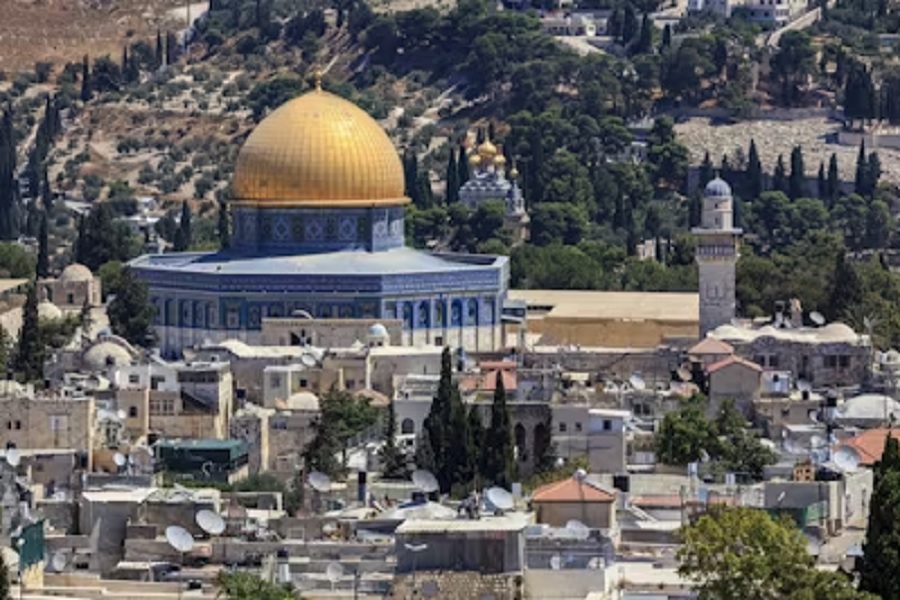
Palestinian Issue
The Palestinian issue, and the Gaza Strip in particular, has been a burning wound in global politics for the past seven decades. It is not just a dispute over a piece of land, but a complex issue linked to identity, sovereignty, justice, human rights, and colonial history. Various powerful countries in the world have periodically presented peace plans to resolve the conflict, but most of them have either failed or caused further hardship for the Palestinian people.
The presidency of Donald Trump (2017-2021) has been particularly controversial in this regard. What the Trump administration called “peace” was in fact a political and diplomatic framework that deepened the imbalance of power, gave unconditional support to Israel, and consistently ignored the Palestinian position. Gaza, which was already suffering from siege, poverty, and war devastation, became even more isolated and oppressed as a result of Trump’s policies.
Gaza: A Brief Background
The Gaza Strip is one of the most densely populated areas in the world. A population of about two million, a limited area, and an Israeli siege since 2007 have turned the region into an “open prison.” There are severe restrictions on food, water, electricity, medicine, and movement. Periodic Israeli military operations destroy Gaza’s infrastructure, while the international community remains largely a silent spectator.
In such circumstances, the moral imperative of any “peace policy” was that it should first and foremost focus on ending the humanitarian crisis, ending the siege, and protecting the civilian population. But Trump’s policy seems to be moving in the opposite direction.
The ideological framework of Trump’s “peace policy”
The Trump administration’s basic ideology was that the Palestinian issue was not a political issue but an economic one. In their view, if the Palestinians were provided with economic opportunities, investment, and employment, they would give up their demands for political freedom, statehood, and basic rights.
This thinking was even more problematic in several respects:
- It presents the Palestinian struggle as a mere “poverty” issue
- It ignores occupation, siege, and military repression
- It gives secondary status to human dignity and the right to political self-determination
This idea proves to be even more unrealistic in the context of Gaza, because as long as the siege remains, no economic plan is possible to implement in practice.
“Deal of the Century” and Gaza
Trump’s most famous plan, which he called the “Deal of the Century,” was actually tantamount to a complete rejection of the Palestinian position.
Key points regarding Gaza
- Proposing to place Gaza under Israeli security control
- Completely isolating Hamas by designating it as an illegal and terrorist organization
- Making the lifting of the siege conditional on Palestinian political conditions
- Using humanitarian aid as a tool of political pressure
All of these points place the Israeli security narrative at the centre rather than the collective rights of the people of Gaza.
Recognizing Jerusalem as Israel’s capital: indirect effects on Gaza
Trump’s recognition of Jerusalem as Israel’s capital was ostensibly a symbolic decision, but its effects reached as far as Gaza.
- The Palestinians felt that the United States was no longer a neutral mediator
- Protests in Gaza escalated, which were violently suppressed
- Israel received a message that it would not have to pay any international price for its actions
The decision further fuelled the already-existing frustration and anger in Gaza.
Ending UNRWA Funding: Collective Punishment
A very serious decision by the Trump administration was to end funding for the United Nations Relief and Works Agency for Palestine Refugees (UNRWA).
In Gaza:
- Millions of people rely on UNRWA for health, education, and food
- The end of funding closed schools, increasing pressure on hospitals
- Children, women, and the elderly were directly affected
This move amounted to collective punishment rather than peace, deepening the humanitarian crisis in Gaza.
Hamas, Resistance, and a Simple Narrative
Trump’s policy presents Gaza as a “Hamas problem.” In this narrative:
- Civilians are ignored
- The resistance is separated from its historical and political context
- All forms of violence are unilaterally blamed on the Palestinians
This simple and biased narrative cannot be the basis for a lasting peace.
Power imbalance and a one-sided definition of “peace”
Peace is only possible when the parties are treated as equals In Trump’s policy:
- Israel exists as a powerful, sovereign state
- The Palestinians, especially the people of Gaza, are a weak, besieged and powerless party
- All conditions are imposed on the weak party
This is not peace, but a model of “peace through dominance”.
Complete disregard for human rights
In Gaza:
- A large number of children are suffering from mental trauma
- Clean water and electricity are the main problems
- The health system has been destroyed by repeated bombing
The mention of human rights in Trump’s peace policy is either completely absent or is merely formal. Any peace policy that ignores human rights loses its moral legitimacy.
Relations with Arab countries and the isolation of Gaza
The Trump administration described the normalization of Israel’s relations with some Arab countries as a great success. But the result was:
- Gaza became more diplomatically isolated
- The Palestinian issue receded from the Arab world’s agenda
- Israel gained acceptance without any concessions
All this at the cost of the people of Gaza.
Peace or surrender?
If Trump’s policy in the context of Gaza could be summed up in one sentence, it would be:
“The silence of the weak on the terms of the strong”
This is not peace, but a demand for surrender. Such a policy is not only unjust, but also leads to further violence and instability in the long run.
Conclusion
Donald Trump’s peace policy towards Gaza is an example in which the word “peace” was used repeatedly, but its fundamental principles-justice, equality, human dignity, and the right to self-determination-were consistently violated.
The people of Gaza were:
- Deprived of political existence
- Collectively punished
- Trying to silence them through economic bribery
History tells us that peace established without justice is not sustainable. The Gaza issue is also proof of this principle. Until the Palestinian people, especially the citizens of Gaza, are recognized as a human being, a nation, and a political party, any American or international “peace policy” will remain a mere paper claim.