Punjab is the most populous province of Pakistan. It contains several major cities of the country Lahore, Faisalabad, Rawalpindi, Multan and Gujranwala. It is the land of 5-rivers and once known as the granary of East and is the lifeline of Pakistan. All the major rivers of the country namely, Indus, Jhelum, Chanab, Ravi, & Sutlaj flow through this province. They originate from the Himalayas and pass from northwest to southwest. The province is playing a leading role in agricultural production, although industry makes a substantial contribution. Punjab has also more than 48 thousand industrial units. The small and cottage industries are in abundance. There are 39,033 small and cottage industrial units. The crafts in the Punjab are of two types, the crafts produced in the rural areas and the royal crafts, which flourished in the urban centers particularly in Lahore. The former include cotton textiles, basketry, embroidery etc. while the latter are tile and woodwork skills, ivory, silver and gold work, naqqashi and architectural crafts etc
Language:
Punjabi is an important language in Pakistan. It is even spoken and understood in areas beyond the confines of Punjab. It is used as the vehicle of common expression. Punjabi is a very rich language. Particularly it is rich in mystical and romantic poetry. The poetic work such as Heer Ranjha by Waris Shah, Saif Maluk by Mian Muhammad Baksh, Yousaf by Maulvi Abdus – Sattar and Maulvi Ghulam Rasul are considered to be the classics of the Punjabi language.
Dress:
A great variety of dresses are worn by the Punjabi’s. National dress is attaining popularity. The typical Punjabi still wear dhoti and turban. Hukka is his constant companion. Khussa with dhoti and turban, most of the Punjabi’s wear Khussa. It is the traditional shoe which Punjabi’s wear in routine life and in the marriage functions.
Food:
Punjabi’s are fond of many things. They usually like to eat saag and makai ki Rotee, Dal, Chawal, Biryani, and many other things. In marriage ceremonies mutton curry with Rotee is served to baratees. Then tea is served. In summer, at noon, they usually drink Lassee, in breakfast; they eat butter with naan or parathea.
Folk and Dances: Punjabi’s passionately loves folk tales and songs. The known legends of Sassi- Punnu, Sohni-Mahiwal and Heer-Ranjha are a great source of amusement for them; Punjabi dances-luddi and bhangra also provide great amusement and happiness for them.
Bhangra:
Bhangra is a dance of joy performed at harvest time and other festive occasions in the Punjab. Various arm and leg movement involving flinging arms up award and jumping characterize the bhangra. Loud sounds accompany rhythmic drum beats of bhangra.
Crafts of Punjab:
Punjab is the land of many crafts and here each art enjoy a place all its own. Here we see countless gems of such skills and notability that their fame is world wide of the crafts. Folk women of Punjab are engaged all over the province in the creation of beautiful basketry work.Chaj, changair, mats and prayer rugs of all kinds are woven for the use of people. Basketry of Pakistan is famous for all its art and its artistry all over the world. Book raks tiffin baskets waste paper baskets and other piece are notable items in the rang. Other major crafts of Punjab are;
BASKTRY:
Folk women from Punjab are engaged all over the province in the creation of beautiful basketry work. Chaj, changair, mats and rugs of all kinds are woven for the use of people. Basketry of Pakistan is famous for its art and its artistry all over the world. Books racks, tiffin baskets, waste paper baskets and other artistic pieces are notable items in the basketry range.
Embroidery:
The embroidery of the Punjab is very skilled more so the intricate phulkhari work colour of all kinds and skilled labour creates this most important and admirable example of our folk artistry. Each area has its own most exquisite motif and each pair of Punjab is able to bestow to embroidery a character and grace all its own. Brown, rust, indigo, red, scarlet and black crate the most flamboyant and myriad charade.
Rilli:
Rilli is a very decorative craft and uses printing, appliqué and embroidery. On very expensive material the rilli artisan can create modes and mixtures of unsuppressed beauty. In the cholistan area rilli is favorite art and all over the Punjab a mode of art which is greatly appreciated especially by the village folk. The bed sheet, bed spread, floor rug and shawl is the most useful expressions of the rilli craft.
Block printing:
Sculpture designs of all kinds are created in this mode of folk craft upholstery curtain and the dining sheets are the examples of the ingenious articles created by block printing. the symmetrical designs are created a beauty which is very unique of Punjab. Block printing on silk is a special article of this craft which is manly done in Multan and Lahore. The animal’s figures and motifs of block printers from Punjab are incomparable in their excellence and design.
Pottery:
Clay craft I one of the earliest of mans creations. he with his love of beauty and skill has made it into a most expressive mode of expression. The terra-cotta art has been developed into an ingenious mode. In the Cholistan and Bahawalpur region is created pottery of paper thin quality. That is an example of skill not found anywhere else. The potter’s wheel in the hands of artisan is a tool from which most exquisites’ art is produced. The glazed pottery too is of great charm and appreciation. In the embossed work of Gujarat region the tile maker transforms ordinary clay into objects of undying beauty. The beat example of exquisites’ tiles work is found in the Wazir khan mosque of Lahore city which boasts of so much else in the folk crafts of Punjab.
Stone crafts:
The forts of Pakistan are the living example of the stone craft of the land. The sculpture in red stone and marble is the most that impresses the tourist. The Lahore fort, the Shalimar gardens, the Badhahi mosque, the emblems and figures in many other forts citadels and regions are expressive of the stone craft legacy. The modern age, taxila to boasts of unique specimens in sculpture. Lahore and Chino it is famous for the production of very exquisite and delicate wood curios.
Waving:
The waves of Punjab are looked upon with great love and admiration because he is the textile factory of his region. The cloth he waves, the hand-woven khaddar is rough but for the villagers most loved and desired. The spinning wheel and the charkha is a device used for spinning of thread and the khadi is upon what the cloth is woven. This is not the only cloth, soft muslin too we get which is used for kurtas and turbans of the men. The brown khaddar of the Sahiwal region is very rare and beautiful. The art of the charkha is the most developed in Lahore, Multan, Jhang, Sargodha, Kasur and Jhelum areas. Blod coulor geometric designs horizontal and verticals impressions to waving give a splendor and grace all their own.khes and large bid rough bed sheets are one of the most useful product. The wavers used create. The bell adorned in the most voluptuous dress is an image of beauty. The acha for the lady and lungi are slightly less decorative garnment bold in design through not in coulor is what is woven for the men. The malmal khaddar s cloth of finer quality is woven too for kurtas and other lighter garnments. The Multani crafts man has won fame for tapestry waving. This is most often indigo and white. Other coulour schemes are black, yellow, orange and green. The horizontal and vertical impression are most exquisitely created. Bd covers, cushion covers, prayers rugs, mats and other house hold linen too is produced. The lacha and lungi cloth as woven by the village waver is used now by foreigners for shirs and blouses.
Carpets:
Carpets of Pakistan have received wide recognition abroad. The carpet wavers of Lahore and Baluchistan used both the Turkish and the Persian knot for their art. They have imagined most beautiful patterns upon their prized Varity of carpetery. They come mostly in the form of the hunting garden of floral carpet.
Wood work:
Wood carving involving intricate design has for long been associated with Muslim culture and tradition in the sub continent. Our craftsmen retain their distinctive standard of skill inherited from their ancestors. There is an extra ordinary variety in wood work which of course is governed by factors like availability of types of wood in different regions; requirements of the people and traditions retained by ability of superior wood in the N.W.F.P regions has fostered this craft as popular occupation. Brass, Bone inlay and ornamental carving are termed as traditional work for which Chiniot is famous.Kashmiri craftsmen excel in delicate workmanship on walnut wood, the soft quality of the wood enabling the artisan to carve the most fascinating intricate patterns in Arabesque or jail. All over the land crafts are engaged in wood carving and produce furniture and wooden curios of unsuppressed quality. The artisan of Punjab in wood carving uses the skills of carving. The artisan of Punjab in wood carving uses the skills of carving, in sizing, coloring and inlaying. Walnut wood furniture is famous worldwide for the art and delicacy with which it is created. Chiniot is famous for brass inlayed woodwork. Laquer work is found in Khaniwal, Kasur and Chiniot. Choice of colour and design vary from place to place. Black, white and brown are favorite colour in the Punjab. Beds and beds legs, low chairs or pihris, picture stand and swings were created and now with a new love of folklore in the land are fashionable items in drawing rooms. Other things that are created in wood work are bowl, powder boxes, spice containers, mirror frames, toys, imitation fruit and vegetable.
Metal work:
Metal craft is the most well produced at Lahore, Wazirabad, Sialkot and Gujranwala, at Wazirabad, we produce excellent cutlery. Daggers and knives, swords and stilettos are produced as specimens of great beauty. The plough, the hoe and the sickle that are emblems of our rustic and rural heritage find production here. Floral pots with pictorial designs are decorative objcts. The old city of Monjodaro with its seal artisan skill is at its highest. The surahis and aftabas are beautiful metal containers that are famous for their artistry and splendor. Panels in relief with intricate design are decorative specimens. Metals craft with chasing, perforation and repousse is much in demand.
Jewelry:
Jewellery is the termed as one of the largest communications of craftsman in Pakistan. Beautiful ornaments are designed both in folk and modern traditions. Silver is the common jewellery metal used in the Punjab.
Leather:
Leather and decoration of it in chain-stitch is a favourit craft in the Punjab, Balochistan and adjoin districts of Dera Ghazi Khan which produce leather art of excellent quality. Weavers put in endless labour and love to produce leathr mats, bags, purses, belts ,hats etc. The Salim Shahi Jooti of leather stitched and embroidered with gold or silver thread is a great boon of tis ara,the truned up toe of the Potohar region adds more worth to the leather craft. The Punjabi jooti of Lahore is another attraction ,the Khussa of this region is very famous. The special thing of a Punjabi shoe is that both pieces of pair are identical and each can be put on either foot. The lather industry of the Punjab is rich and most interesting .
Camel skin:
The camel skin works as found in Bahawalpur and Multan is the most beautiful and replete in its worth. The arabesque images of Mughal tradition are used to sublimate the skill of this art. In term of beauty and expression of the folkloric wonder of the Punjab is nothing that would be same lovely than the camel skin works as done in the Punjab. The camel skin lamp reflects the lights through it. Other things produced are camel skin vases, bottles, bowl, dishes and other curios.
Multani:
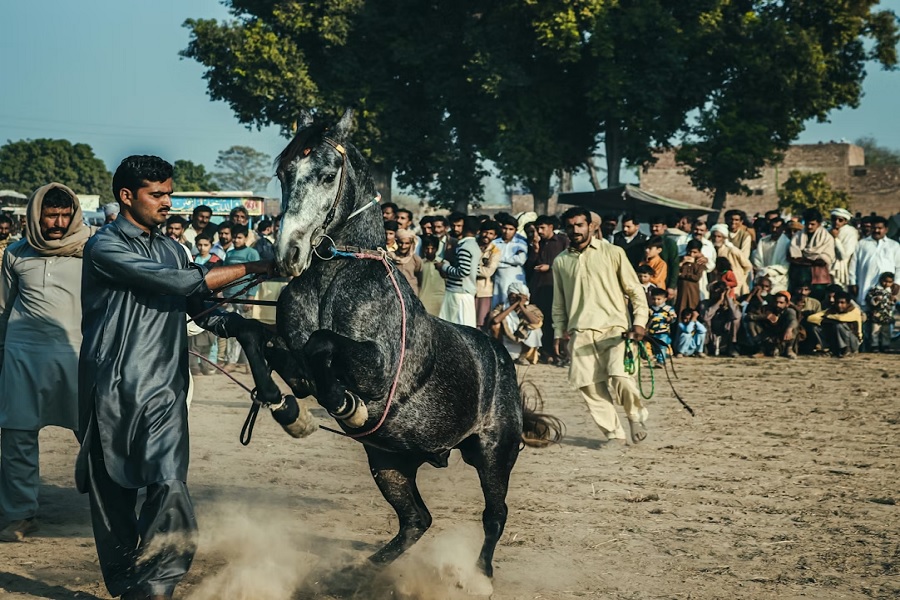
One of the professional groups that become quite popular here was the Multan horse dance party. This dance was known as Gate Ghore Ka Raqs (cardboard horse dance) the dancer slips into the body of a cardboard horse and performs the dance. Now steel and aluminum is used instead of cardboard, which makes the horses durable but make it quite heavy for the dancer. Full size camels and elephants are also added to the group at times to create more excitements. This dance apparently has its roots in central Asia but little is known about how the tradition developed here.
Bone work:
Ivory has lost its place. Now bone work is the rage of the day. The images and impressions as created by working into bone to create is an art of great skill. Multan, Chiniot and Lahore are areas of the bon workmanship. Horns too these days are used for carving i.e. umbrella handles, combs, hair pains, buttons ashtrays, toys, pen stands and candle stick, objects that the pulse and soul of the people of the Punjab. Camel bone is used to create Bangles, bracelets, key chains, chess pawns, car rings and now following Mughal traditional designs jewellery to is being produced of many kinds which in demand. The craft of the Punjab is its integral soul and its crafts create its entity.
Punjabi Regional Music:
Music from the Punjab province includes many different varieties. The traditional music utilizes instruments like the Dhol, flute, dholak, and tumbi. The most commonly recognized form of Punjabi music, bhangra, is music which is based on the drum rhythms of the Dhol, although its modern popularity has led to the use of many new instruments and electronic sound sampling in this form.