
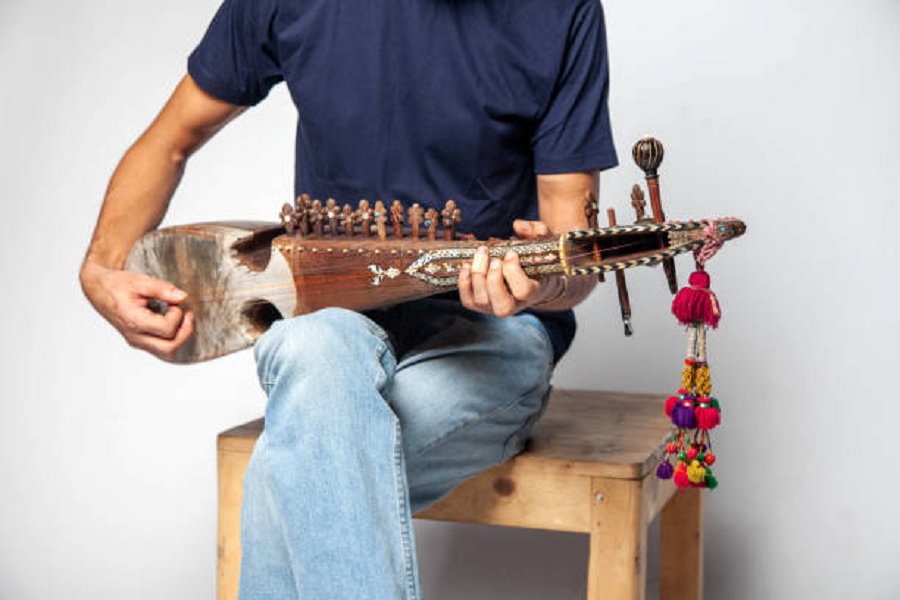
Surando / Saro / Saroz
 The name of this instrument, Surando is based on ‘surayindah’, a Persian word for one who produces tunes. The Surando is a common instrument in the Sindh, Balochistan and Frontier regions regions of Pakistan. In the Frontier region this instrument is known as called Saro, while in Balochistan it is called Saroz. The main part of the instrument is made with a variety of different types of wood, while the strings are traditionally constructed from horse hairs and intestines of sheep or goat. This instrument can have a varying number of strings, with more simple versions having 5-7 strings and the most complex having 11-13 strings (images and information from Baloch 1988).
Murli / Punji
The Murli or Punji is a wind instrument which consists of two parts; the upper part is made of a dried and hollowed gourd which acts as the main sound

chamber. The lower part is constructed from two reed pipes which are joined together into a double barrel form and positioned below the sound chamber. On most of these instruments the reed section has eight holes, which are used to play tones for music. However, in some parts of Sindh there is an additional hole in the lower back end of the right pipe. This instrument is known as a Murli in Sindh, and a Punji in other parts of Pakistan. It is most commonly recognized for its popular use by snake charmers throughout South Asia (image and information from Baloch 1988).
Pava / Beenu / Alghoza / Bainsiri / Doneli
 The simple double flute called a Pava or Beenu reportedly developed from a children’s version known as the bainsiri. These are often played in Sindh. The identifying feature of this instrument is that it involves two paired flutes which are played together. While the most common form of this instruments involves two flutes of equal length, some have differently sized flutes joined together. These are also commonly called ‘Alghoza’ in Sindh. In Baluchistan there is a version of the double flute called the Doneli. The Doneli is considered best played as a solo instrument, although it can also be used in accompaniment to other instruments, especially stringed instruments (first image and information from Hessnetworks 2002, second image and information from Baloch 1988).
Damboor
 The damboor is a stringed instrument originally invented in Egypt; it reportedly traveled to South Asia through the Middle-East and Persia. The instrument was popular with early Arab musicians, and remains in use in Sindh today. The Damboor traditionally had four strings, although new forms of the instrument are typically five stringed. The chamber is commonly made from one single hollowed out piece of wood (image and information from Baloch 1988).
Danburo / Kamach / Kamachi
 The Danburo is a stringed instrument traditionally found in the Kohistan and Las Bela regions of Pakistan. A smaller version of this instrument of this type (with a smaller chamber and long tail) is called Kamach or Kamachi. The Danburo has a large elliptical body made of wood, and three steel strings. It is most typically played using a small wooden pick called the Janok (image and information from Baloch 1988).
Sarod
 The Sarod is an instrument derived from the Central and South Asian instrument the Rubab or Rabab. This string instrument has a metal fingerboard with no frets, and numerous strings. The membrane covering provides resonance in the sound chamber. It is usually played with a coconut pick. The Sarod is used in many parts of Pakistan including Baluchistan and Azad Kashmir (first image from Bina, second image and information from Courtney 2004).
Bubul Tarang / Benju / Banjo
 This is a fairly new instrument in Pakistan, but is popular today in Balochistan. The benjo or banjo is basically a dulcimer. The Balochi version of the banjo is a large version, approximately one meter in length. It is often used in pieces with sarod accompaniment. This can be constructed with a variety of materials. It produces a bright, metallic sound (information from Baloch 2000 and Courtney 2004, image from Courtney 2004).
Zerbagali
 This is a percussion instrument with a single head in an hourglass shape. The instrument is often found in Turkey and Iran as well as Pakistan. The body of the zerbagali is made from baked clay, which is decorated in different ways regionally. Many of these instruments are made by master potters who create designs in the clay before firing it. The head of the drum is typically animal skin, affixed to the clay body with cloth string (Information and image from Gold and Schalliol 2004).
Tumbi

The Tumbi is a traditional Punjabi stringed instrument, which has only one string and produces a high tone. The body of the instrument is made of various types of wood and the string of metal. Tones are produced with fingering positions at the top of the string. The Tumbi has become well known in recent times in the international music scene as it is used in a popular Punjabi style of music called bhangra (information from Lancashire 1997, Byrne 2003 and Nagpal; image from Nagpal).
Chimta
 The chimta is another percussion instrument commonly used in the popular Punjabi form of music called bhangra. This is an instrument made of two long flat pieces of metal, typically iron, with pointed ends on one side and a ring on the other end. Along the sides of the metal strips are bells or loosely attached simple metal pieces. The player holds the joint in one hand and strikes the two sides together to produce a chiming sound (information from Nagpal, image from Indian Musicals 1998).
Kartal
 The Kartal are a percussion instrument similar to the chimta in effect, if not design They are simply a pair of wooden blocks or frames that have been outfitted with small metal pieces or bells. The two blocks are struck together to provide a rythem for many types of folk music in South Asia (information and images from Courtney 2004).
Sarangi / Saringda
 The sarangi/saringda are instruments closely related to the Saro instrument described above. This instrument is very common in Indian classical music and comes in many varieties. It is a stringed instrument, traditionally made with animal gut strings and a body carved from a single piece of wood. There is no fret on the neck, and the bridge is placed on a skin which is stretched over the body of the instrument. The sarangi/saringda varies in form because each school and region have a preferred shape, tuning method, and number of strings for these instruments. The saringda is commonly thought of as the folk version of the sarangi (Image and information from Courtney 2004).
Daira
 This is a single headed percussion instrument which is not only found in Northern South Asia, Central Asia, and the Middle East, but also in parts of the Russian polar regions. This simple drum is formed by attaching a skin cover onto a wooden ring with glue and cloth ties. This is similar to the Persian daira and the Turkish del. Some daira have metal pieces attached to give them a tambourine-like quality. The daira is usually plyed while held vertically on one hand and beat with the other (Information and image from Gold and Schalliol 2004).
Tambur
 The tambur is a stringed instrument which is often used in Afghanistan as well as Pakistan. It can have a varying number of strings, commonly about eighteen, which can be made of metal, animal guts, or nylon. These strings are positioned over a resonating chamber which is often made of a hollowed gourd. The tambur has a long, hollow wooden neck which has tuning pegs on the side. It is often used either as a solo instrument or as an accompaniment for voice pieces (Information and image from Gold and Schalliol 2004)
Daff /Dapphu /Daffali
 The Daf is quite similar to the daira, as a percussion instrument with one head that is played like a tambourine. In South Asia it is also called a dapphu, daffali. This instrument is usually quite large, about two feet across, and does not commonly have metal attached to produce a jingling sound. The daf is primarily a folk instrument (Information and image from Courtney 2004).